Research and publications
Full publications list: (NASA/ADS), (PDF)
Publication statistics
My top 5 cited records accumulate a total of 231 citations, contributing to an h-index
of 7 (first author h-index: 3).
My career-wide personal 2-year impact factor is I̅F̅2 = 13.5
± 8.8.
Authors who cite me the most
- Walch, S. (24)
- Pfrommer, C. (21)
- Ostriker, E. (19)
- Kim, C. (18)
- Klessen, R. (17)
- Glover, S. (16)
- Pakmor, R. (15)
- Girichidis, P. (13)
- Bryan, G. (13)
- Naab, T. (12)


Image caption
Recent publications
Rathjen, T.-E. and Linsky, J. L., arXiv:2608.27603, 2026
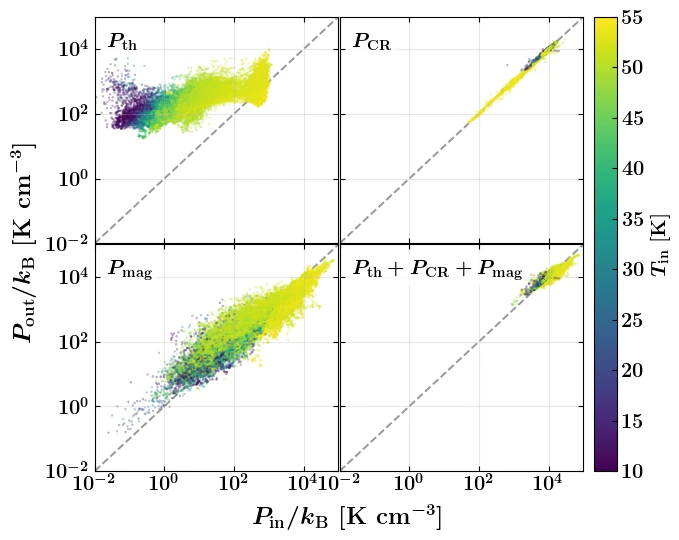
The Local Bubble around the Sun contains hot, supernova-heated plasma, yet the Local Leo Cold Cloud lies only 11–24 pc away and contains gas near 20 K. How such cold gas can exist there has remained unclear.
Using SILCC magnetohydrodynamic simulations, we show that cold diffuse gas can form locally from nearby cold and thermally unstable material and survive for several million years in a warm–hot, feedback-driven environment. Cosmic rays provide a pervasive non-thermal pressure floor, with magnetic fields adding further support. The simulated gas naturally forms filamentary and sheet-like structures, suggesting that the LLCC need not have entered the Local Bubble as a pre-existing cold cloud.
Watanabe, K., Walch, S., Rathjen, T.-E. et al., arXiv:2510.11988, revised 2026; accepted in A&A
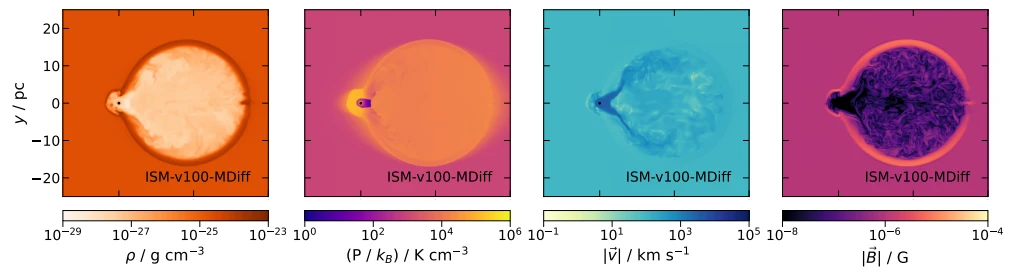
We model the early evolution of stellar-wind bow shocks with three-dimensional cosmic-ray magnetohydrodynamic simulations in the advection–diffusion limit. The revised models follow up to 500 kyr and vary stellar velocity and cosmic-ray diffusion. Simplified post-processing estimates upper limits on gamma-ray and synchrotron emission. Diffusion changes the morphology and predicted luminosity, but the model underpredicts the observations, partly because of weaker winds and omitted stellar magnetic fields. The influence of cosmic rays depends on efficient acceleration at the forward shock.
Brugaletta, V., Rathjen, T.-E. et al., MNRAS, 543, 4286, 2025
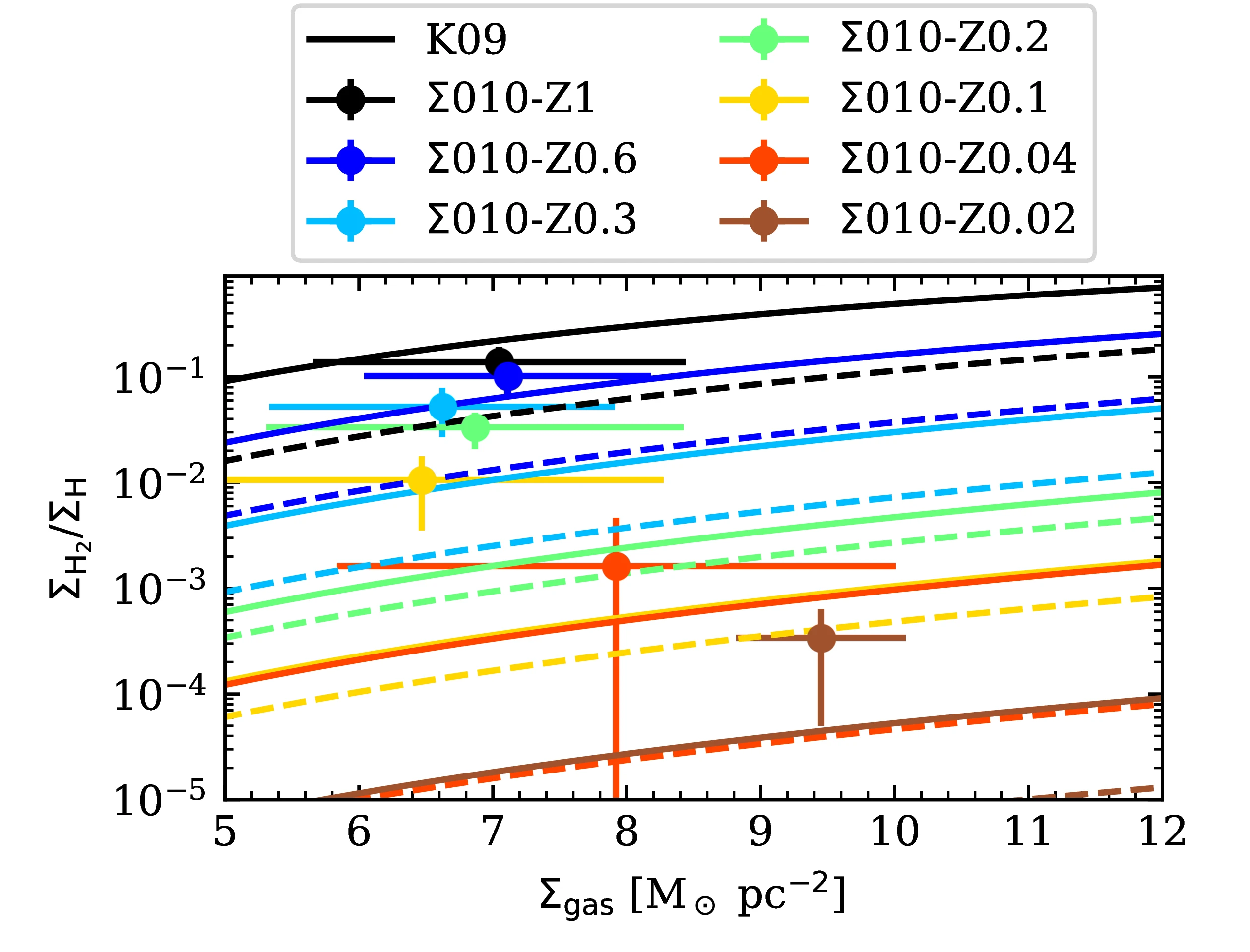 The gas-phase metallicity strongly influences heating, cooling, and star formation in the galactic interstellar
medium (ISM). Using magnetohydrodynamic simulations from the SILCC project with the FLASH code, we study
metallicities from one-fiftieth to solar at a fixed gas surface density of
10 M⊙ pc−2. The models include non-equilibrium thermo-chemistry, stellar
radiation, winds, supernovae, and cosmic rays. As metallicity decreases within this model suite, the star
formation rate drops by more than a factor of ten, the cold gas fraction declines, and the warm gas fills
most of the ISM. Dense gas
forms fewer structures, and the molecular hydrogen fraction in the densest regions decreases. These results
show how metallicity influences star formation and ISM structure under the simulated conditions.
The gas-phase metallicity strongly influences heating, cooling, and star formation in the galactic interstellar
medium (ISM). Using magnetohydrodynamic simulations from the SILCC project with the FLASH code, we study
metallicities from one-fiftieth to solar at a fixed gas surface density of
10 M⊙ pc−2. The models include non-equilibrium thermo-chemistry, stellar
radiation, winds, supernovae, and cosmic rays. As metallicity decreases within this model suite, the star
formation rate drops by more than a factor of ten, the cold gas fraction declines, and the warm gas fills
most of the ISM. Dense gas
forms fewer structures, and the molecular hydrogen fraction in the densest regions decreases. These results
show how metallicity influences star formation and ISM structure under the simulated conditions.
SILCC -- VIII: The impact of far-ultraviolet radiation on star formation and the interstellar medium
Rathjen, T.-E. et al., MNRAS, 540, 1462, 2025
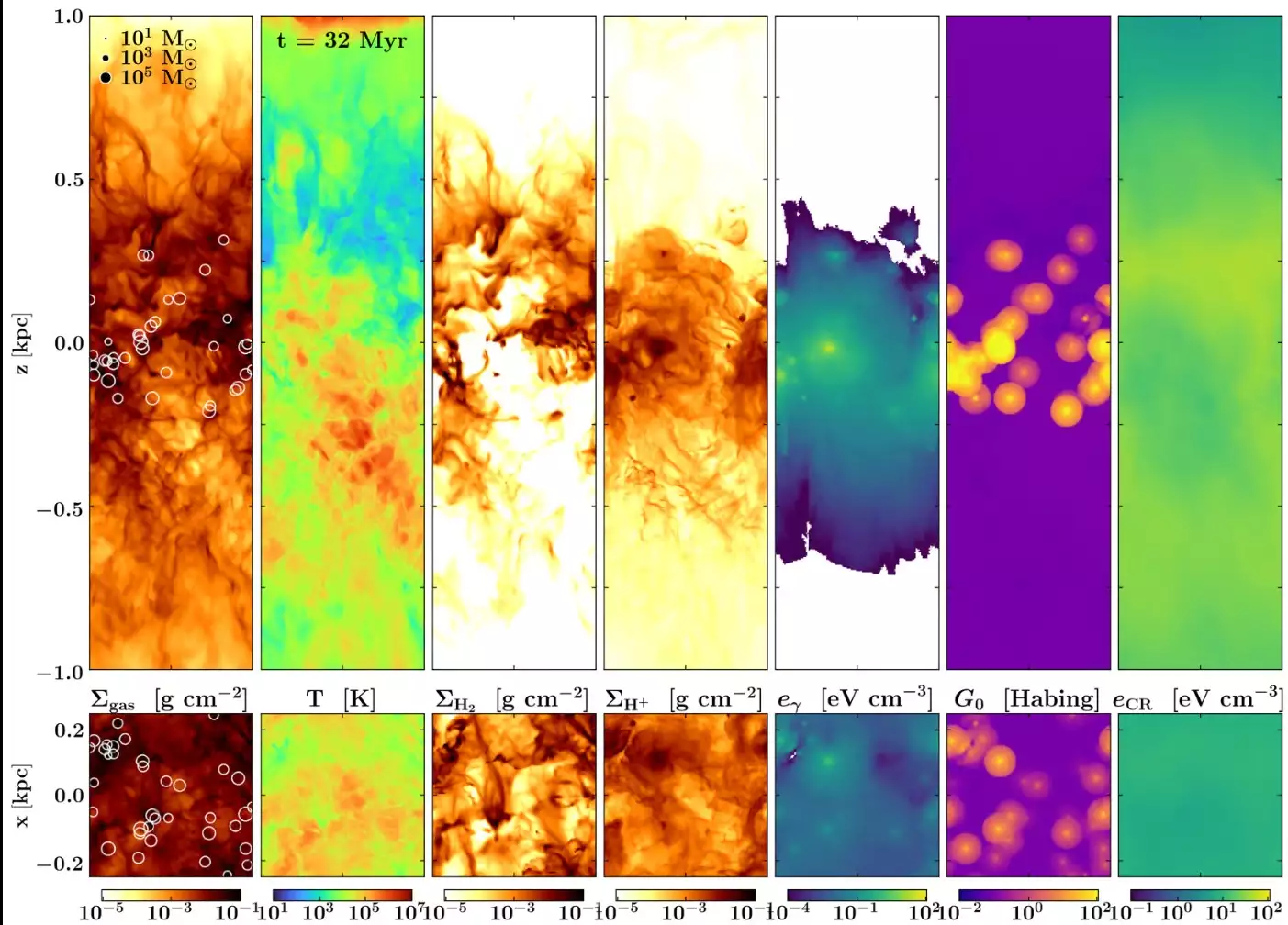 This SILCC study investigates the role of far-ultraviolet (FUV) radiation in star formation
within the multiphase interstellar medium using magnetohydrodynamic simulations. While FUV radiation can
significantly heat dust and affect the gas phases near star clusters, we find its overall impact on star
formation rates is minimal compared to other feedback mechanisms like ionising radiation, stellar winds, and
supernovae. FUV radiation mainly reduces star formation burstiness and promotes a diffuse molecular gas phase,
but it does not strongly influence the integrated star formation rate. The research highlights the complex
interplay between radiation and the interstellar environment, refining our understanding of how stars shape
their surroundings.
This SILCC study investigates the role of far-ultraviolet (FUV) radiation in star formation
within the multiphase interstellar medium using magnetohydrodynamic simulations. While FUV radiation can
significantly heat dust and affect the gas phases near star clusters, we find its overall impact on star
formation rates is minimal compared to other feedback mechanisms like ionising radiation, stellar winds, and
supernovae. FUV radiation mainly reduces star formation burstiness and promotes a diffuse molecular gas phase,
but it does not strongly influence the integrated star formation rate. The research highlights the complex
interplay between radiation and the interstellar environment, refining our understanding of how stars shape
their surroundings.
Brugaletta, V., Rathjen, T.-E. et al., MNRAS, 537, 482, 2025
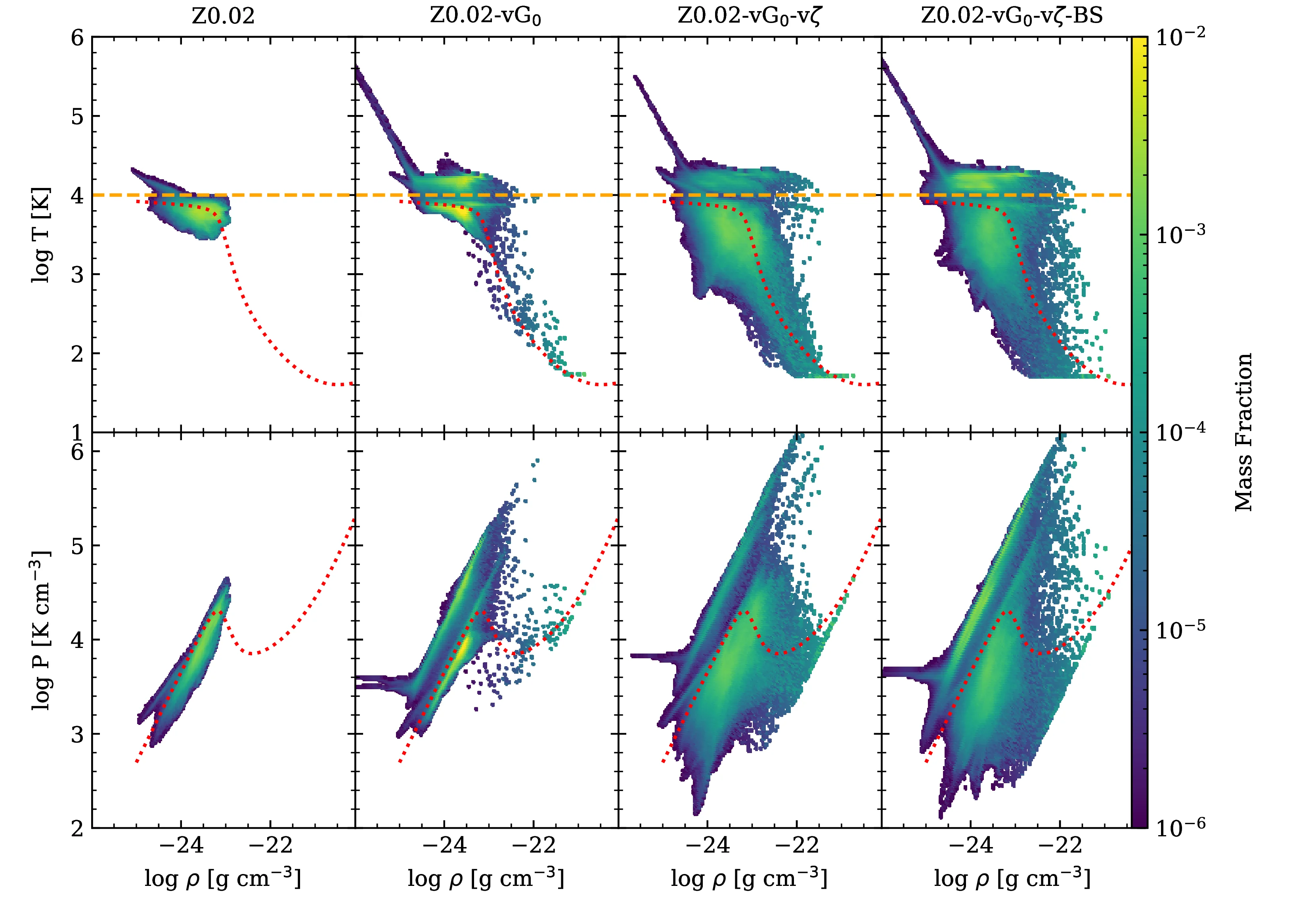 Low-metallicity environments experience inefficient cooling and reduced photoelectric (PE) heating due to low
dust-to-gas ratios. Using SILCC project simulations with 0.02 Z⊙, we include non-equilibrium
chemistry, stellar feedback (FUV/EUV radiation, winds, supernovae), and cosmic-ray (CR) heating. CR heating,
variable in space and time, often dominates over PE heating. Models with uniform CR ionisation suppress star
formation, while variable rates allow localised star formation in cool, pristine gas. In these low-metallicity runs,
insufficient star formation prevents stellar feedback from driving outflows from the mid-plane.
Low-metallicity environments experience inefficient cooling and reduced photoelectric (PE) heating due to low
dust-to-gas ratios. Using SILCC project simulations with 0.02 Z⊙, we include non-equilibrium
chemistry, stellar feedback (FUV/EUV radiation, winds, supernovae), and cosmic-ray (CR) heating. CR heating,
variable in space and time, often dominates over PE heating. Models with uniform CR ionisation suppress star
formation, while variable rates allow localised star formation in cool, pristine gas. In these low-metallicity runs,
insufficient star formation prevents stellar feedback from driving outflows from the mid-plane.
Fotopoulou, C.M., Rathjen, T.-E. et al., MNRAS, 534, 215, 2024
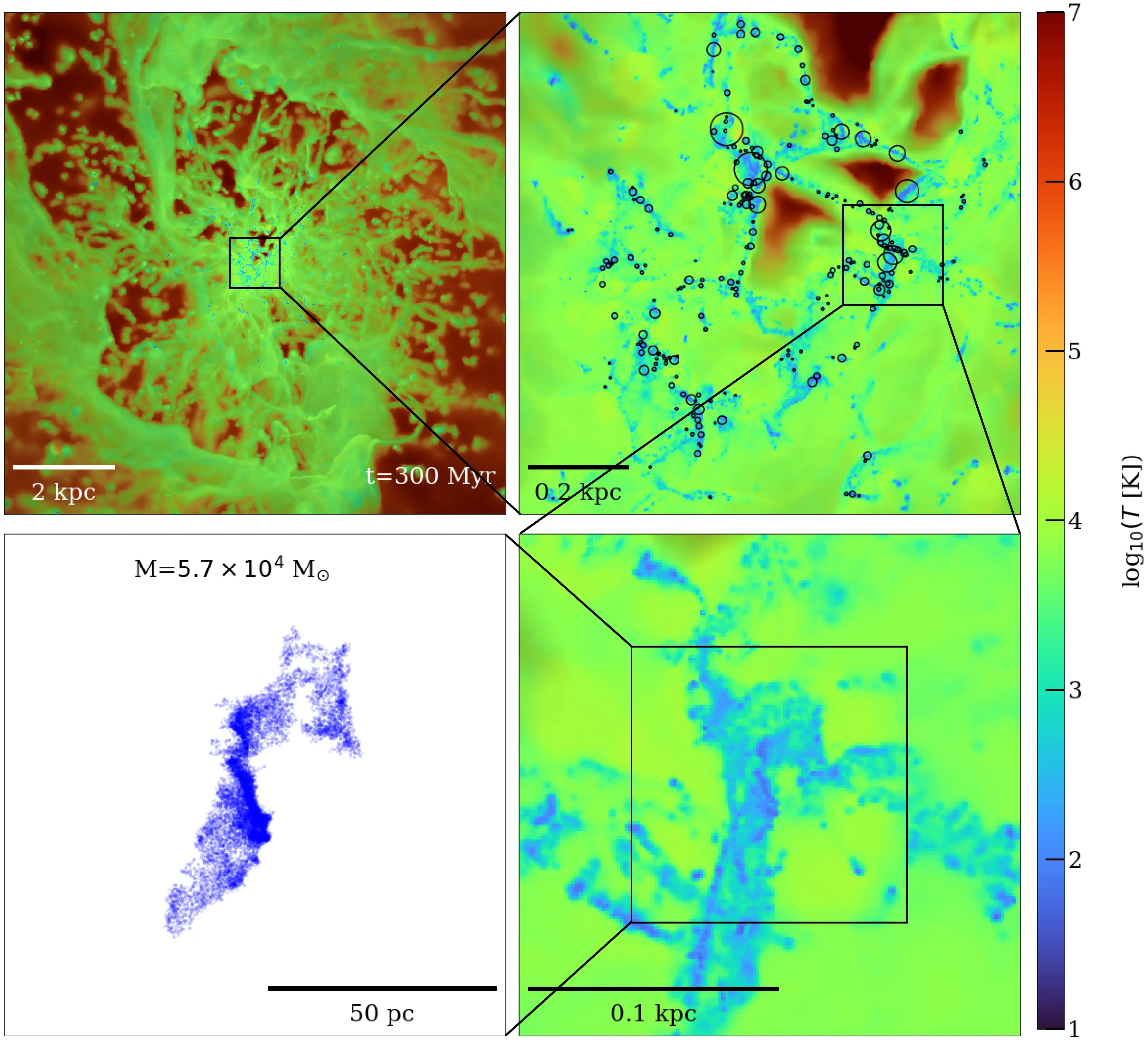 We analyse the cold gas phase in a low metallicity starburst from a high-resolution hydrodynamical simulation of
a gas-rich dwarf galaxy merger, part of the GRIFFIN project. The simulation resolves the multi-phase
interstellar medium with non-equilibrium chemistry and includes interactions from individually sampled massive
stars through HII regions and supernovae. During the starburst, the ISM is dominated by cold (T < 300 K)
filamentary clouds with a mass range of 102.6 to 105.6 M⊙, following a power
law distribution (dN/dM ∝ M-1.78). These clouds obey Larson's relations and exhibit an
exponential lifetime distribution with an e-folding time of ~3.5 Myr. The average lifetime scales with peak cloud mass below
104 M⊙; this relation flattens at higher masses, with lifetimes below 10 Myr.
We analyse the cold gas phase in a low metallicity starburst from a high-resolution hydrodynamical simulation of
a gas-rich dwarf galaxy merger, part of the GRIFFIN project. The simulation resolves the multi-phase
interstellar medium with non-equilibrium chemistry and includes interactions from individually sampled massive
stars through HII regions and supernovae. During the starburst, the ISM is dominated by cold (T < 300 K)
filamentary clouds with a mass range of 102.6 to 105.6 M⊙, following a power
law distribution (dN/dM ∝ M-1.78). These clouds obey Larson's relations and exhibit an
exponential lifetime distribution with an e-folding time of ~3.5 Myr. The average lifetime scales with peak cloud mass below
104 M⊙; this relation flattens at higher masses, with lifetimes below 10 Myr.
Ebagezio, S., Rathjen, T.-E. et al., MNRAS, 525, 5631 2023
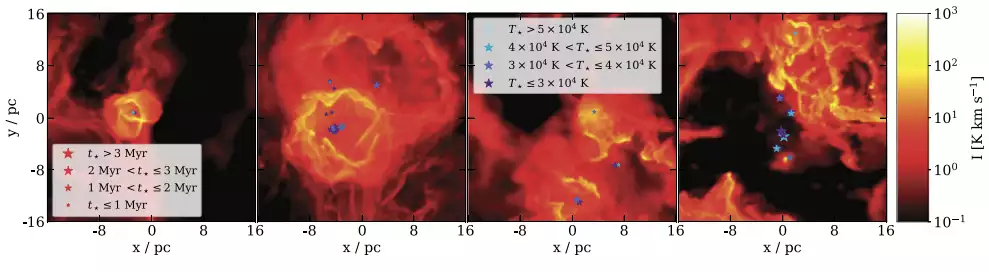 We analyse SILCC-Zoom project simulations' synthetic emission maps (12CO, 13CO, [C II]) of molecular clouds. Our
zoom-in simulations track H2, CO, and C+ evolution in the interstellar medium with and without radiative stellar
feedback. Post-processing with CLOUDY addresses higher carbon ionisation due to stellar radiation in H II
regions. Synthetic [C II] emission maps reveal depletion around feedback bubbles, attributed to C+ ionisation
into C2+. For both CO isotopologues, the cloud-averaged CO/[C II] luminosity ratio shows no clear trend with the
molecular hydrogen mass fraction and is therefore not a reliable measure of that fraction. Chemical equilibrium assumption introduces intrinsic errors in chemical
abundances, luminosities, and ratios.
We analyse SILCC-Zoom project simulations' synthetic emission maps (12CO, 13CO, [C II]) of molecular clouds. Our
zoom-in simulations track H2, CO, and C+ evolution in the interstellar medium with and without radiative stellar
feedback. Post-processing with CLOUDY addresses higher carbon ionisation due to stellar radiation in H II
regions. Synthetic [C II] emission maps reveal depletion around feedback bubbles, attributed to C+ ionisation
into C2+. For both CO isotopologues, the cloud-averaged CO/[C II] luminosity ratio shows no clear trend with the
molecular hydrogen mass fraction and is therefore not a reliable measure of that fraction. Chemical equilibrium assumption introduces intrinsic errors in chemical
abundances, luminosities, and ratios.
Makarenko, E., Rathjen, T.-E. et al., MNRAS, 523, 1421 2023
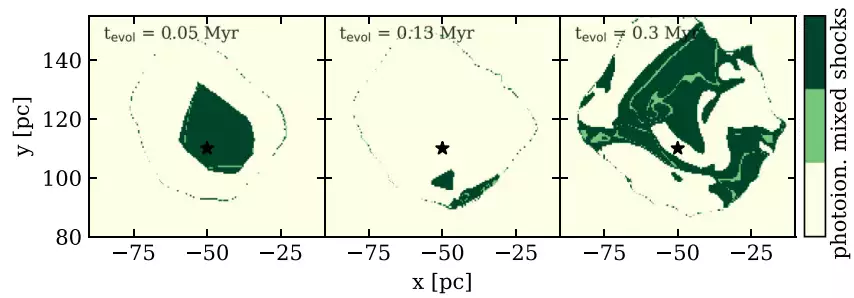 We introduce a FLASH code post-processing module for simulating Supernova (SN) remnants' cooling radiation,
using collisional excitation data from MAPPINGS V. Applying it to an SNR simulation, we find dominant EUV
emissions, while optical lines ([O III], [N II], [S II], Hα, Hβ) are typically more observable. Our shock
detection scheme reveals [S II] and [N II] emissions from the thin shell, and [O III], Hα, and Hβ from the hot
gas within the SNR bubble. Optical lines are influenced by the SNR's structure and projection, with 10–80%
reduction in line luminosity due to line-of-sight absorption. Contaminating background radiation subtraction is
essential for accurate SNR classification on oxygen or sulphur BPT diagrams. The electron temperatures and densities inferred from the synthetic observations agree with the simulated
values but are sensitive to the assumed metallicity.
We introduce a FLASH code post-processing module for simulating Supernova (SN) remnants' cooling radiation,
using collisional excitation data from MAPPINGS V. Applying it to an SNR simulation, we find dominant EUV
emissions, while optical lines ([O III], [N II], [S II], Hα, Hβ) are typically more observable. Our shock
detection scheme reveals [S II] and [N II] emissions from the thin shell, and [O III], Hα, and Hβ from the hot
gas within the SNR bubble. Optical lines are influenced by the SNR's structure and projection, with 10–80%
reduction in line luminosity due to line-of-sight absorption. Contaminating background radiation subtraction is
essential for accurate SNR classification on oxygen or sulphur BPT diagrams. The electron temperatures and densities inferred from the synthetic observations agree with the simulated
values but are sensitive to the assumed metallicity.
Rathjen, T.-E. et al., MNRAS, 522, 1843 2023
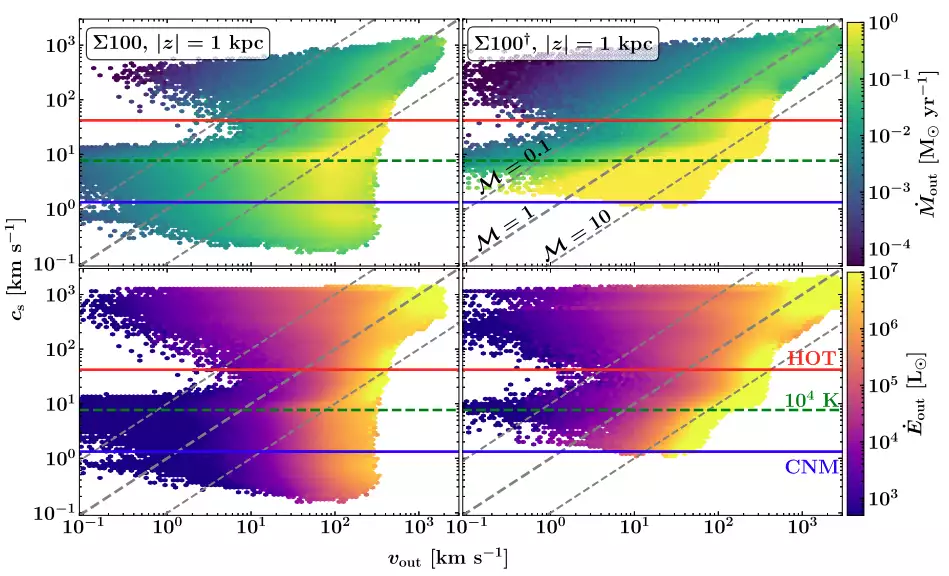 We present MHD simulations of the star-forming interstellar medium in stratified galactic patches (Σgas = 10,
30, 50, 100 M☉ / pc^2). The SILCC project includes non-equilibrium thermal and chemical
processes. The sink-based model incorporates stellar winds, UV radiation, core-collapse supernovae, and cosmic
rays (CR). Simulations align with the observed Σgas-ΣSFR relation. CRs impact outflows; without them, a
two-phase to single-phase transition occurs. With CRs, three phases persist, dominated by the warm phase. CR
impact on mass loading decreases with higher Σgas, maintaining factors around unity, independent of ΣSFR.
Vertical velocity dispersions of the warm ionised medium (WIM) and cold neutral medium (CNM) correlate with
ΣSFR^0.20, consistent with observations. In the absence of stellar feedback, no correlation is observed. WIM's
velocity dispersion is ~2.2 times higher than CNM, matching local observations.
We present MHD simulations of the star-forming interstellar medium in stratified galactic patches (Σgas = 10,
30, 50, 100 M☉ / pc^2). The SILCC project includes non-equilibrium thermal and chemical
processes. The sink-based model incorporates stellar winds, UV radiation, core-collapse supernovae, and cosmic
rays (CR). Simulations align with the observed Σgas-ΣSFR relation. CRs impact outflows; without them, a
two-phase to single-phase transition occurs. With CRs, three phases persist, dominated by the warm phase. CR
impact on mass loading decreases with higher Σgas, maintaining factors around unity, independent of ΣSFR.
Vertical velocity dispersions of the warm ionised medium (WIM) and cold neutral medium (CNM) correlate with
ΣSFR^0.20, consistent with observations. In the absence of stellar feedback, no correlation is observed. WIM's
velocity dispersion is ~2.2 times higher than CNM, matching local observations.
Rathjen, T.-E. et al., MNRAS, 504, 1039, 2021
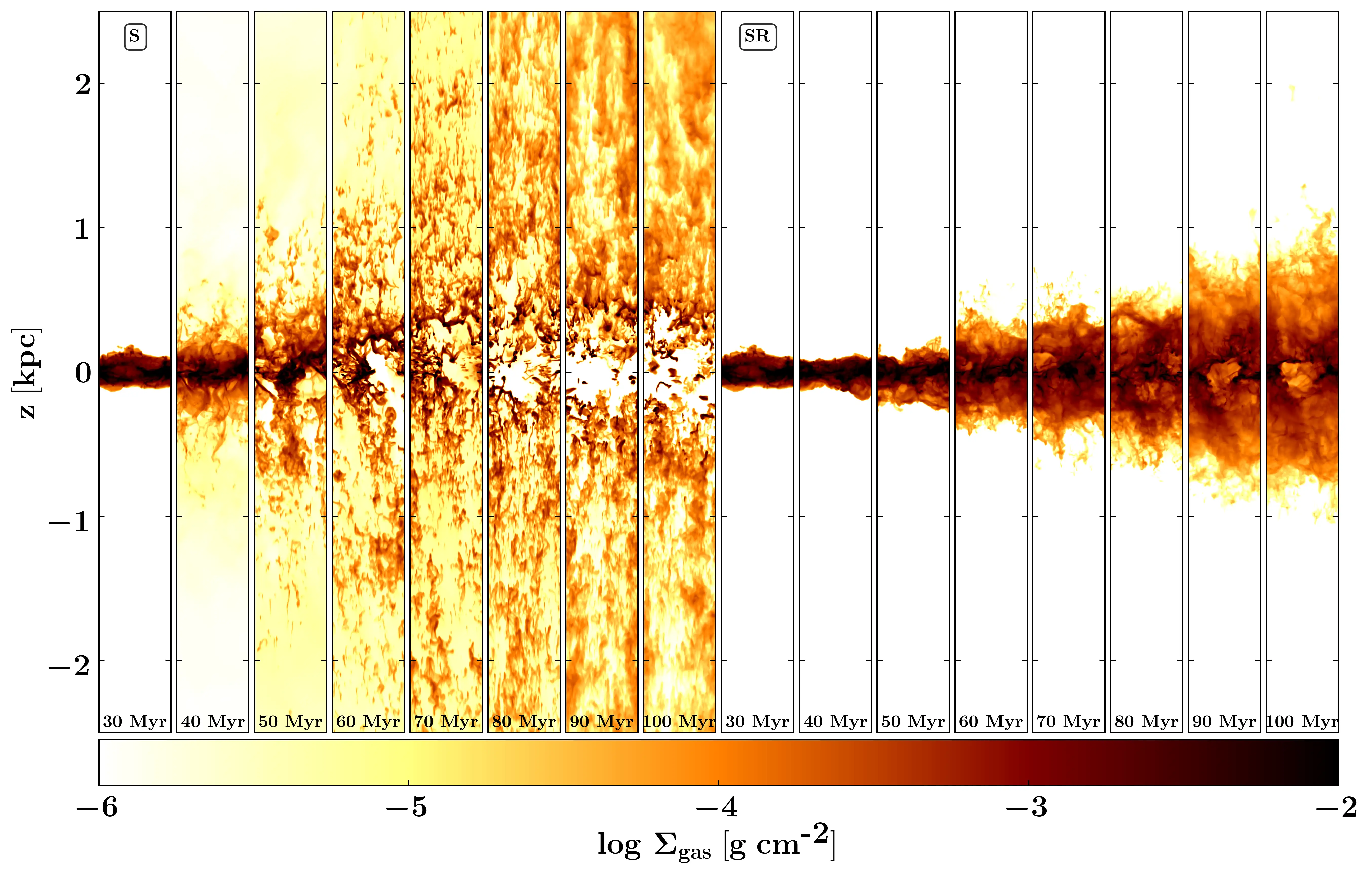 We present simulations of the multiphase interstellar medium (ISM) under solar neighbourhood conditions,
incorporating thermal and non-thermal processes, star cluster formation, and feedback from massive stars:
stellar winds, ionising radiation (using the TREERAY method), supernovae, and cosmic rays (CR). We investigate
the impact of feedback mechanisms on the ISM, finding that radiation and winds from massive stars regulate star
formation, aligning with observed star formation rates and outflows. While supernova-only feedback leads to
highly clustered star formation, the inclusion of radiation reduces star cluster masses and enhances consistency
with local conditions. Over the 100 Myr interval studied, cosmic rays have a moderate effect on
star formation and multiphase gas structure and can cool the outflows that develop.
We present simulations of the multiphase interstellar medium (ISM) under solar neighbourhood conditions,
incorporating thermal and non-thermal processes, star cluster formation, and feedback from massive stars:
stellar winds, ionising radiation (using the TREERAY method), supernovae, and cosmic rays (CR). We investigate
the impact of feedback mechanisms on the ISM, finding that radiation and winds from massive stars regulate star
formation, aligning with observed star formation rates and outflows. While supernova-only feedback leads to
highly clustered star formation, the inclusion of radiation reduces star cluster masses and enhances consistency
with local conditions. Over the 100 Myr interval studied, cosmic rays have a moderate effect on
star formation and multiphase gas structure and can cool the outflows that develop.
If you want to build a ship, do not drum up the men to gather wood, divide the work, and give orders. Instead, teach them to yearn for the vast and endless sea.